
The Role of Physical Education in Play-Based Learning
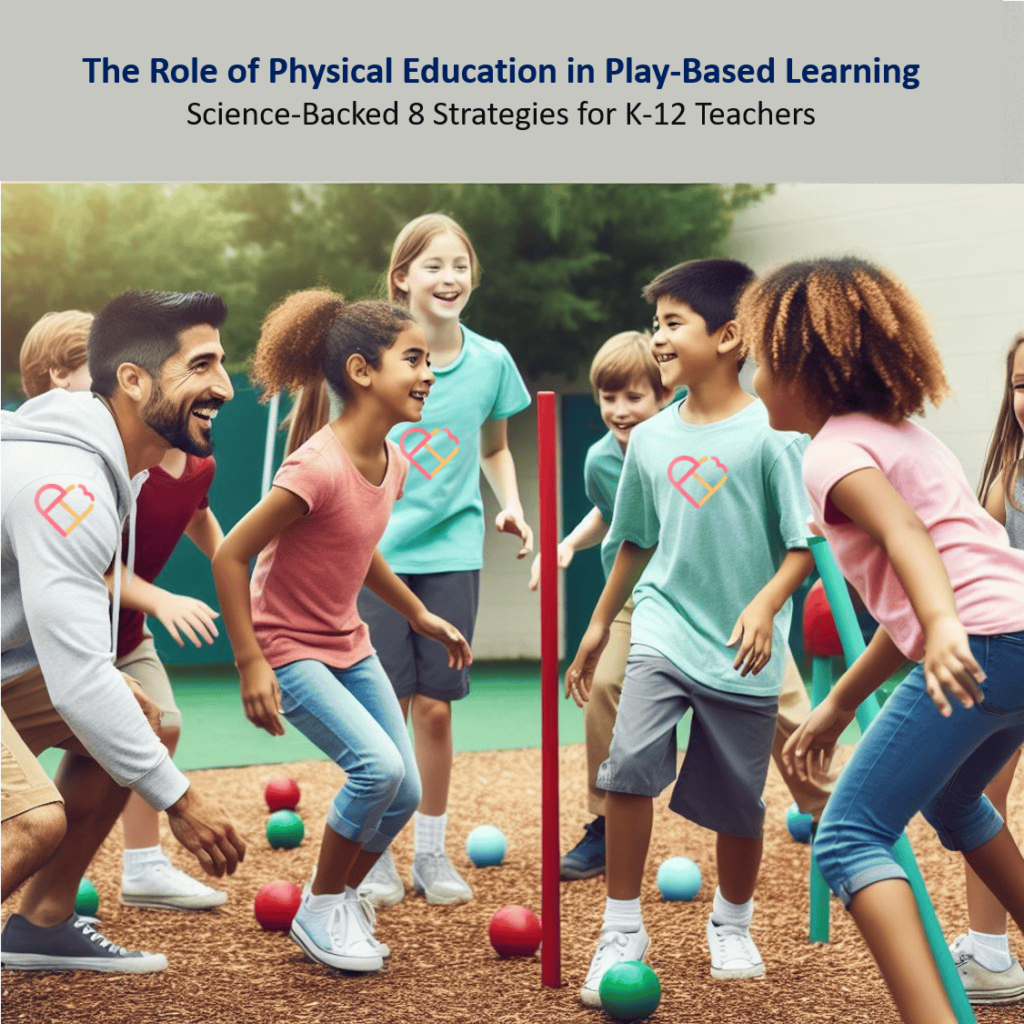
Play-based learning represents a paradigm shift in how educators approach physical education. Rather than emphasizing isolated skill drills and competitive outcomes, play-based PE harnesses the natural joy of movement, games, and creative exploration to build motor competence, cognitive skills, and a lifelong love of physical activity. The evidence is compelling: A 10-week play-based after-school intervention enhanced coordinative abilities and physical fitness in 12-year-old students compared to traditional PE classes. Students increased their light physical activity by 4.7 minutes daily and decreased sedentary time by 10.2 minutes. More importantly, game-based PE curricula show measurable improvements in student enjoyment and emotional engagement, with research documenting positive emotional outcomes in children participating in play-based activities. For K-12 educators, this shift means reimagining the gym as a learning laboratory where physical challenges, game strategy, and peer collaboration become the scaffolding for holistic development. This guide explores the neuroscience, practical strategies, and implementation tools PE teachers need to maximize the benefits of play-based learning. What Is Play-Based Learning in Physical Education? Play-based learning in PE is an instructional approach that prioritizes games, exploration, and student agency within physical activity contexts. Unlike traditional PE that focuses on skill repetition through drills, play-based learning embeds skill development within game scenarios where students make decisions, adapt to changing conditions, and experience immediate feedback. Key characteristics of effective play-based PE include: Research comparing playful pedagogies to traditional instruction shows that play-based approaches are consistently more effective at fostering social, emotional, physical, cognitive, and creative skills simultaneously. This integrated development is not incidental—it reflects how children’s brains actually learn best. The Science Behind Play-Based Learning in PE How Play Rewires the Brain: Neuroplasticity in Action The brain’s capacity to form new neural connections in response to experience—a phenomenon called neuroplasticity—is the foundation of all learning. Play-based activities are among the most powerful neuroplasticity activators available to educators. When children engage in play, they stimulate the cerebral cortex (the brain’s learning center) through sensory-rich experiences. More importantly, play activates the prefrontal cortex, the region responsible for executive function, decision-making, and impulse control. During small-sided games and guided play scenarios, students practice evaluating options, anticipating opponent moves, and adjusting tactics—all while their prefrontal neurons strengthen through repeated activation. This structural brain development has measurable consequences. Motor development-focused exercise training in PE contexts demonstrates large to very large effect sizes (Cohen’s d = 1.13 to 1.55) for gross motor skill improvement compared to free play or traditional curriculum. The mechanism: targeted, playful challenges stimulate motor and sensory coordination in the cerebral cortex through complex, multimodal activities rather than isolated drills. The Dopamine Effect: Motivation, Memory, and Engagement Dopamine, a neurotransmitter released during pleasurable and rewarding experiences, directly impacts three cognitive functions critical to learning: For PE teachers, this has direct application: incorporating elements that boost dopamine—surprise, choice, teamwork, progressive challenge, positive peer recognition—transforms PE from a compliance activity into a dopamine-driven learning environment where students naturally engage and retain motor skills more effectively. Motor Skill Development: The Foundation for Lifelong Engagement Motor skill competence is not merely a physical achievement—it predicts physical activity levels, fitness outcomes, and academic performance throughout childhood and into adulthood. A “positive spiral of engagement” occurs when children develop motor confidence; they feel competent, seek more physical activity, improve further, and maintain active lifestyles. Conversely, low motor skill competence creates a “negative spiral” where initial struggles lead to reduced participation and declining long-term physical fitness. Play-based PE directly addresses this spiral. By embedding skill practice within game contexts where students get high repetitions, frequent success experiences, and peer encouragement, teachers accelerate motor skill development. Small-sided games, for example, provide 3 to 4 times more ball touches and decision-making opportunities per player than traditional full-team games, allowing faster skill consolidation and confidence building. Play-Based Learning Strategies for PE Teachers Small-Sided Games: Maximize Participation and Skill Development Small-sided games (SSGs)—such as 3v3, 4v4, or 5v5 versions of sports—are the most research-supported implementation strategy for play-based PE. These formats simultaneously address multiple teaching objectives that traditional large-group games cannot. Why Small-Sided Games Work: Implementation Example:Instead of dividing a class of 24 students into two large 12v12 soccer games, create six concurrent 4v4 games. Each game has clear boundaries marked with cones, varied challenges (some focusing on possession, others on shooting), and rotations allowing every student to play continuously. This structure maximizes their active time, provides 2–3 hours’ worth of deliberate practice within a 40-minute lesson, and keeps all students engaged. Guided Play: Balancing Freedom and Intentional Learning Guided play sits at the intersection of free play and structured instruction. The teacher intentionally designs the game, structures the rules, and provides subtle scaffolds to nudge students toward specific learning goals—while students retain agency in decision-making and gameplay. Research comparing free play, guided play, and direct instruction shows that guided play produces superior learning outcomes. Students in guided play developed larger vocabularies, better spatial skills, and greater conceptual understanding than those in free play. The mechanism: the teacher’s intentional structure ensures that students encounter the learning target repeatedly within the game context, while the playful nature sustains engagement and dopamine-driven retention. How to Design Guided Play in PE: Classroom Management: Creating a Culture of Engagement Play-based PE requires a management approach fundamentally different from traditional PE. Instead of minimizing “chaos” through strict control, effective play-based teachers orchestrate environments where students are intrinsically motivated to participate and self-regulate behavior. Key Classroom Management Strategies: Practical Implementation Guide: From Theory to Your Gym Step 1: Assess Current Practice and Identify Starting Points Before redesigning lessons, observe what’s working and what could improve. Ask yourself: Baseline answers to these questions help you identify which play-based strategies will have the highest impact in your context. Step 2: Design a Small-Sided Games Unit Select a sport or activity (e.g., basketball, handball, soccer). Plan a 4–6 week progression using small-sided games: Throughout all weeks, create concurrent games at different challenge levels so that students of varying abilities experience appropriate difficulty and frequent success. Step 3: Train Yourself to Observe and Provide Targeted
Beyond Resolutions: Using Data to Make Student Goals Stick
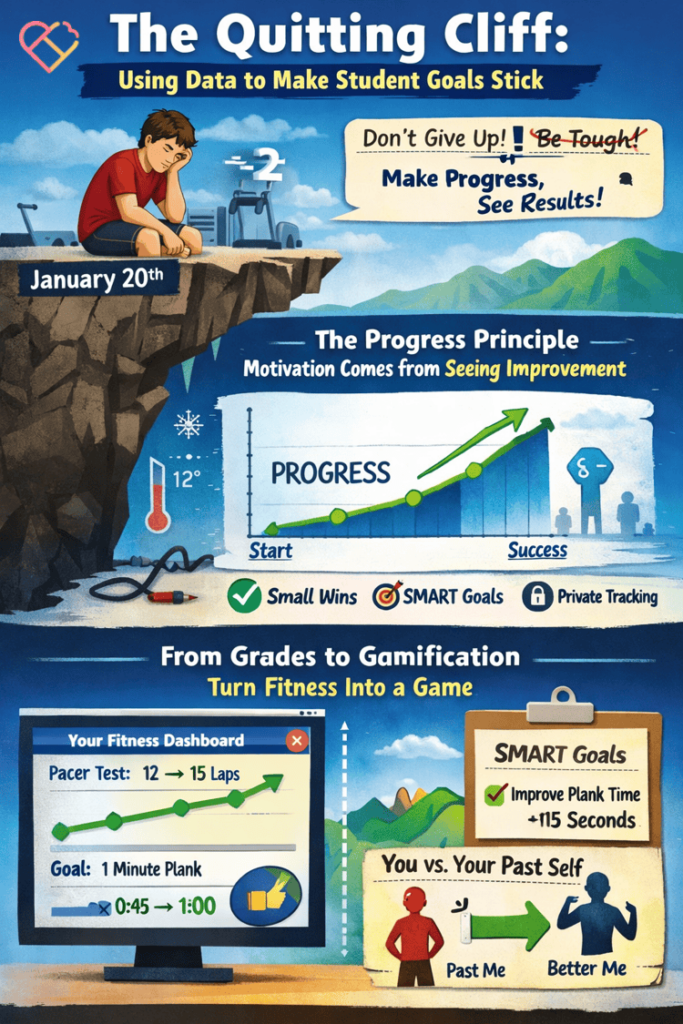
It is the third week of January. We call this “The Quitting Cliff.” On January 1st, your students might have been excited. They were going to “run faster,” “get stronger,” or “actually dress out.” But by January 20th, the novelty of the new year has worn off. The gym is cold, the routine is back, and motivation is plummeting. As teachers, we often try to fix this with speeches about discipline or “grittiness.” But behavioral science suggests that what students really need isn’t a pep talk—it’s a progress bar. Here is the psychology behind why students quit, and how visual data tracking can save your semester. The Science: The Progress Principle Harvard Business School researcher Teresa Amabile discovered a powerful driver of human motivation called The Progress Principle. Her research found that the single most important factor in boosting motivation is not recognition, incentives, or pressure. It is the sense of making progress in meaningful work. To keep students engaged, we have to make the invisible visible. We have to show them the small wins they can’t see in the mirror. Moving from “Grades” to “Gamification” This is where Student Portfolios change the game. When a student logs into PhysednHealth, they don’t just see a letter grade (which feels like a judgment). They see a trend line (which feels like a story). Here is how to use data to hack the Progress Principle in your gym: 1. Visualize the “Micro-Win” A student might not care about a “B” in participation. But showing them a graph where their pacer score went from 12 to 15? That lights up the reward centers of the brain. 2. Set SMART Goals (That Actually Track) “Get fit” is a bad goal because it’s vague. “Improve my plank time by 15 seconds” is a SMART goal. 3. Privacy Builds Confidence Public leaderboards motivate the athletes, but they crush the beginners. Don’t Let Them Quit The “January Slump” isn’t inevitable. It happens when students lose sight of their growth. By putting the data in their hands, you are giving them the map that shows how far they have come. You are turning “exercise” into “progress.” And progress is addictive. Want to give your students their own login? Student Portfolios are included in every PhysednHealth plan. Explore Student Portfolios | Start Your Free Trial