
Why Student Behavior Often Changes at the End of the School Year (and What PE Teachers Can Do About It)
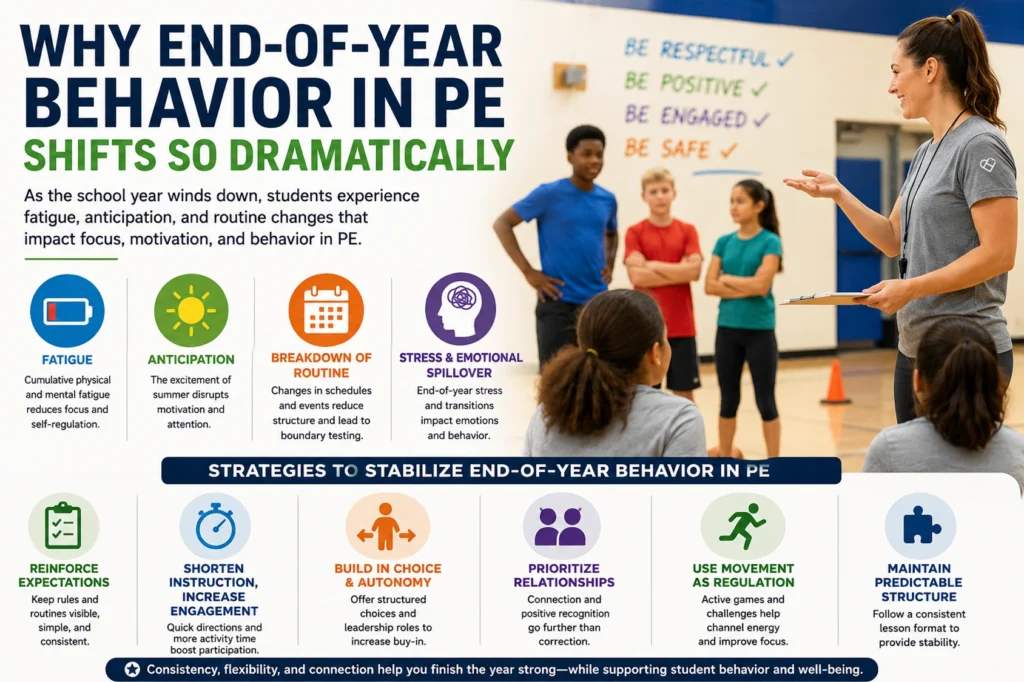
As the school year winds down, many physical education teachers notice a clear shift in student behavior. Focus declines, energy becomes inconsistent, and routines that once worked seamlessly begin to break down. This isn’t just anecdotal—it’s supported by research in cognitive science, behavioral psychology, and education. Understanding the “why” behind end of year behavior in PE is the first step toward maintaining a positive, structured, and engaging environment. 1. Cognitive and Physical Fatigue Build Over Time By late spring, students are experiencing cumulative fatigue. Months of academic demands, testing, and structured schedules take a toll on both cognitive function and self-regulation. Research in educational psychology shows that sustained mental effort reduces executive functioning—skills like attention control, impulse regulation, and task persistence. In a PE setting, this can look like: Even though PE is active, it still requires focus, cooperation, and adherence to rules—skills that are harder to maintain when students are mentally drained. 2. Anticipation of Summer Disrupts Motivation The closer students get to summer break, the more their attention shifts toward what’s next. Anticipation activates reward centers in the brain, making future-oriented thinking more appealing than present tasks. This creates a motivational imbalance: In PE, this often shows up as students rushing through activities, negotiating rules, or disengaging from skill-building tasks. 3. Breakdown of Routine Reduces Behavioral Stability Consistency is one of the strongest predictors of positive student behavior. Toward the end of the year, routines often loosen due to: Behavioral science suggests that when predictable structures disappear, students test boundaries to understand what expectations still apply. In PE, where space, movement, and group dynamics already add complexity, even small disruptions can lead to noticeable behavior changes. 4. End-of-Year Stress and Emotional Spillover While excitement is high, so is stress. Students may be dealing with: This emotional load can manifest physically and behaviorally, especially in PE where students are more expressive and less constrained by traditional classroom norms. Practical Strategies to Stabilize End-of-Year Behavior in PE Maintaining consistency doesn’t mean resisting the energy of the season—it means channeling it productively. 1. Reinforce (Don’t Relax) ExpectationsKeep rules and routines visible, simple, and consistent. Briefly revisit expectations at the start of each class. Consistency provides psychological safety when everything else feels uncertain. 2. Shorten Instruction, Increase EngagementGiven reduced attention spans, shift toward: This aligns with cognitive load theory—less verbal input, more meaningful movement. 3. Build in Choice and AutonomyResearch in motivation (Self-Determination Theory) shows that autonomy boosts engagement. Offer structured choices: This helps redirect anticipation energy into productive participation. 4. Prioritize Relationship-Based ManagementAt this time of year, connection is often more effective than correction. Strong teacher-student relationships improve behavior regulation, especially when routines weaken. 5. Use Movement as a Regulation ToolInstead of viewing high energy as a problem, design activities that absorb it: Physical activity itself helps regulate mood and attention through neurochemical responses (e.g., dopamine and endorphin release). 6. Maintain Predictable Lesson StructuresEven if content changes, keep the format consistent: This structure anchors students even when schedules feel chaotic. A Quick Example in Practice Instead of a long skill lecture during the final weeks, a PE teacher might: This approach maintains structure while adapting to students’ shifting motivation and energy levels. Final Thought End of year behavior in PE is not a loss of control—it’s a predictable response to fatigue, anticipation, disrupted routines, and emotional transitions. When teachers respond with consistency, flexibility, and connection, they can finish the year strong while supporting both student behavior and well-being.