
The PE Compliance Trap: Navigating State Fitness Mandates
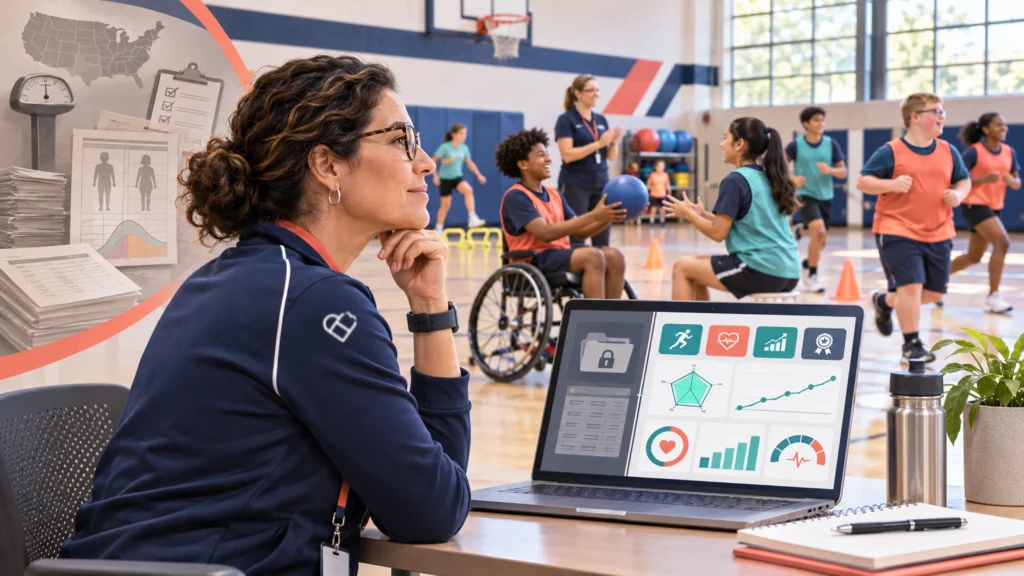
Talk to almost any K–12 physical education teacher today, and they will tell you the same thing: tracking a student’s Body Mass Index (BMI) as a graded metric is a relic of the past. The pedagogy has moved on. Educators know that stepping on a scale in the middle of the gymnasium does nothing to build a lifelong love of movement. But there is a glaring disconnect between the gymnasium floor and the statehouse. While teachers have evolved, many state legislatures and legacy reporting systems have not. Across the country, district coordinators find themselves caught in a “compliance trap.” They are forced to navigate outdated state mandates—often tied directly to their funding—that still explicitly require standardized fitness testing batteries heavily weighted toward body composition. How do PE departments stay compliant with the law without compromising the psychological well-being of their students? The Science vs. The Statute To understand the friction, we have to look at the data. A review of the 2026 National PE Policy Tracker reveals a patchwork of state mandates. Some states have aggressively modernized their physical education requirements, while others still enforce legacy statutes that mandate traditional fitness testing and body composition reporting. The problem is that these legacy statutes directly contradict modern pediatric sports psychology. When a state mandate forces a district to prioritize body composition, it inadvertently works against the ultimate goal of public health funding: creating active adults. Research consistently shows that hyper-focusing on weight and BMI during adolescence triggers fitness anxiety and disengagement. Instead of inspiring students to move more, forcing compliance on body composition metrics actively decreases the likelihood that those students will participate in recreational physical activity after graduation. The Playbook: Navigating Mandates Ethically If your district is legally required to collect this data, you cannot simply ignore the mandate. However, you can control how that data is collected, stored, and emphasized. Here is a playbook for district coordinators to navigate the compliance trap ethically: 1. Wall Off the Required Data If your state requires body composition reporting, treat that data strictly as a compliance exercise, not an educational one. Isolate it completely from a student’s grade. More importantly, ensure your software infrastructure supports strict data isolation. Collecting sensitive health metrics requires rigorous adherence to FERPA and SOPPA. The data should be securely aggregated for state reporting and immediately walled off so it does not become a focal point for the student or the teacher. 2. Shift the Spotlight to Process Metrics You may have to report on mandated metrics, but you get to choose what your department celebrates. Shift the instructional spotlight entirely toward process-oriented assessments. Utilize the TGMD-3 to track mastery of fundamental motor skills, and use assessments like the PACER to track progressive cardiovascular effort. When you build your district dashboards, populate them with these growth curves. Prove your program’s efficacy by showing how students are improving their functional movement, rather than how their body composition is changing. 3. Modernize Your Data Collection The biggest hidden cost of legacy state mandates is the administrative burden. Teachers spend hours recording required fitness scores on clipboards, eating into valuable instructional time. By adopting modern data collection tools—such as AI-powered paper scanners that instantly digitize scoresheets and automated roster integrations—departments can fulfill state reporting requirements in a fraction of the time. Compliance Without Compromise Physical education departments should not have to choose between securing their state funding and protecting their students’ mental health. By understanding the policy landscape, strictly isolating sensitive data, and focusing daily instruction on effort and skill rather than arbitrary physical metrics, district coordinators can successfully navigate the compliance trap. It is possible to check the state’s boxes while still building a gym environment where every student feels empowered to move.