
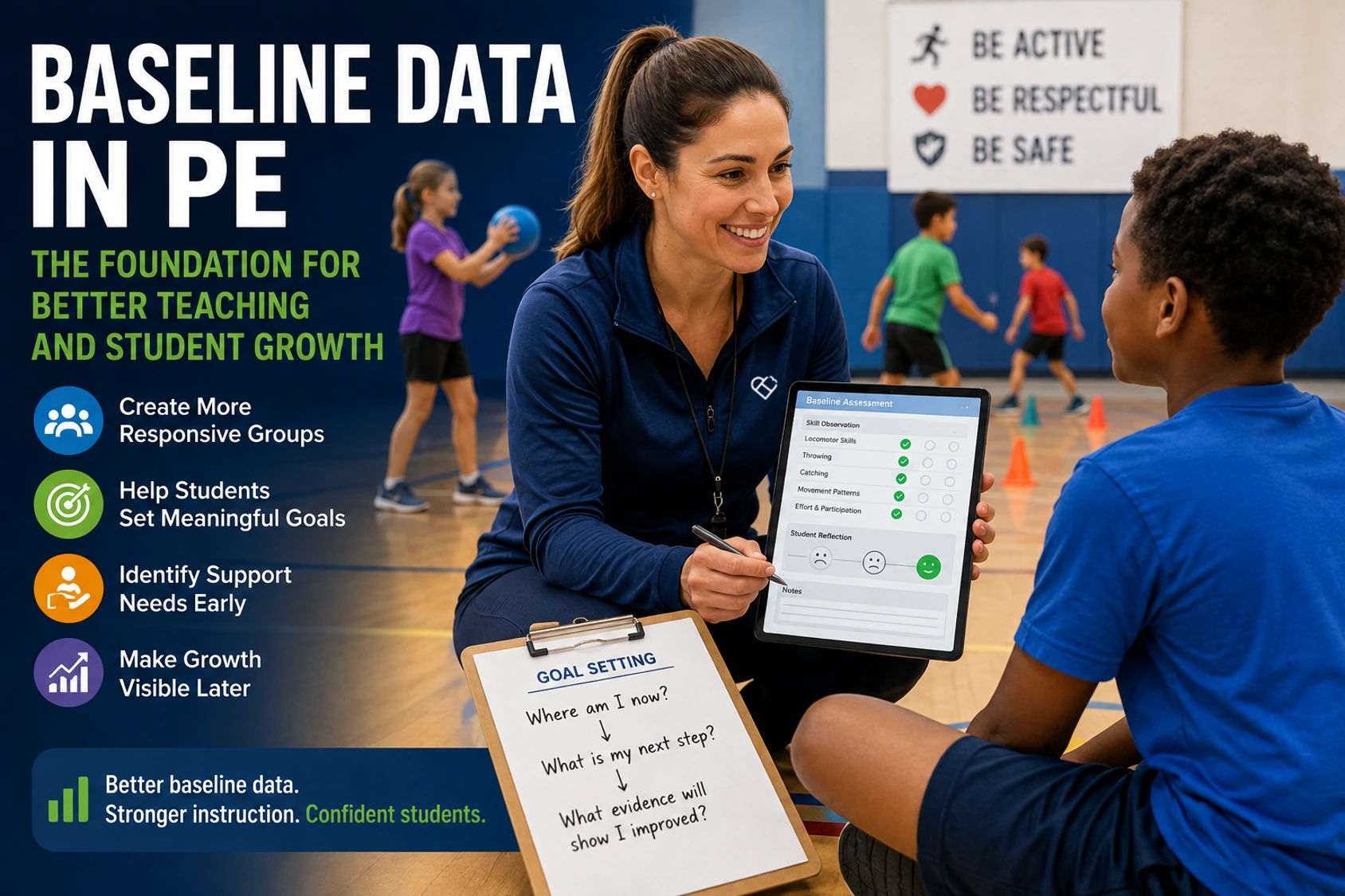
The first few weeks of school are an opportunity to learn far more than students’ names and preferred activities. When PE teachers collect purposeful baseline data in PE, they gain a practical starting point for planning instruction, supporting individual learners, and showing student growth over time.
The goal is not to turn every opening lesson into a test. It is to gather just enough high-quality evidence to answer a few important questions:
- What can students already do?
- What do they understand about movement, fitness, safety, and healthy behaviors?
- Which students need an entry point, extension, modification, or confidence boost?
- What progress should be realistic and meaningful by the end of a unit, semester, or year?
Baseline data is simply evidence of a student’s performance at the beginning of an instructional period. It can include a beginning-of-year skill check, prior assessment data, a knowledge prompt, a student self-reflection, or a portfolio artifact—not just a formal pre-test. When teachers compare that starting point with later evidence, they can make better decisions about progress toward learning goals.ride
Why Baseline Data Matters in PE
High-quality PE assessment should help teachers improve learning, not merely produce a score. Research and professional guidance describe assessment as a way to gather evidence across physical, cognitive, and affective learning—not only fitness outcomes.
Starting with better baseline data in PE helps teachers do four things especially well.
1. Create more responsive student groups
A quick baseline skill observation can reveal patterns that are hard to see during a whole-class activity. For example, in an elementary throwing and catching unit, a teacher might observe whether students:
- Track an object with their eyes
- Step with the opposite foot
- Use an overhand throwing pattern
- Catch with ready hands
- Apply the skill successfully in a simple task
This information can support short-term, flexible grouping. One group may practice foundational movement patterns with larger or softer equipment, while another works on accuracy, decision-making, or applying the skill in a small-sided game.
The key word is flexible. Baseline groups should never become permanent labels such as “low,” “average,” or “advanced.” Data-informed grouping works best when teachers set a clear learning purpose, watch for unequal participation or stigma, and regularly regroup students as their needs change.nwea
2. Help students set meaningful goals
A goal is more motivating when a student understands their starting point. Rather than telling every student to reach the same outcome on the same timeline, PE teachers can help students set goals based on current performance and the specific standard being taught.
For instance, a middle school student who currently completes a locomotor sequence with two of four key cues may set a goal to consistently demonstrate all four cues in a partner-designed sequence. Another student who already demonstrates the cues may focus on applying them with control, rhythm, and spatial awareness in a game or dance context.
This approach shifts the conversation from comparison to growth:
“Where am I now, what is my next step, and what evidence will show that I improved?”
Student self-assessment, goal setting, reflection, and feedback are all identified by SHAPE America as assessment practices that support student growth and motivation.shapeamerica
3. Identify support needs early
Early evidence makes it easier to plan access before students experience repeated frustration. A baseline can identify students who may need:
- Adapted equipment, such as larger balls, visual targets, or lighter implements
- More modeling or visual cues
- A smaller practice space or reduced task complexity
- Peer support and structured partner roles
- Additional challenge through constraints, leadership roles, or tactical decisions
- Support with confidence, participation, communication, or self-management
This is why baseline assessment should include more than a score. A checklist, brief teacher notes, student reflection, and observation of meaningful participation can provide a fuller picture than one timed or fitness-based measure alone.
Accurate and sufficient PE data can make placements, planning, instructional modifications, and feedback more valid and effective. In practical terms, better evidence helps teachers act sooner rather than waiting until the end of a unit to discover that students needed a different pathway.eric
4. Make growth visible later
Without a starting point, it is difficult to show progress convincingly. A final performance score might show that a student met a standard, but it does not necessarily show how far they traveled to get there.
For example:
| Student | Fall skill baseline | Spring evidence | Growth story |
|---|---|---|---|
| A | Uses 2 of 5 dribbling cues | Uses 5 of 5 cues in a small-sided game | Improved technique and application |
| B | Avoids peer leadership roles | Leads warm-up with clear instructions | Improved confidence and communication |
| C | Identifies 1 fitness principle | Explains and applies 4 principles to a personal plan | Improved health literacy |
This evidence can strengthen student-led conferences, progress reports, parent communication, department discussions, and advocacy for PE. SHAPE America highlights data collection, monitoring, evaluation, and dissemination as essential elements of showing the impact of high-quality physical education.shapeamerica
Collect Smart Data, Not Excessive Data
Better baseline data in PE does not mean assessing every standard during the first week. It means choosing a few measures that are aligned, manageable, and useful.
A strong baseline measure is:
- Aligned: It matches an instructional goal, grade-level outcome, or standard.
- Observable: The teacher can see, hear, count, or document the evidence.
- Efficient: It fits naturally into active learning instead of creating long wait times.
- Age-appropriate: Students understand the task and what success looks like.
- Inclusive: Students have multiple ways to demonstrate learning when appropriate.
- Repeatable: The teacher can use a comparable measure later to document growth.
For fair growth comparisons, pre- and post-assessments should use similar instructions, conditions, standards, and levels of cognitive demand. That does not mean the tasks must be identical; it means they should measure the same intended learning.ride
A Practical First-Month Baseline Plan
Instead of scheduling a week of testing, embed short evidence-gathering opportunities into regular PE lessons.
| Area | Simple baseline method | What it tells you |
|---|---|---|
| Motor skills | One-minute teacher observation using a 3–5 criterion checklist | Movement patterns, control, and next instructional steps |
| Knowledge | Three-question entrance prompt or digital check-in | Vocabulary, rules, safety, and health concepts |
| Confidence and interests | Student survey or four-corners response | Preferred activities, perceived competence, concerns, and goals |
| Personal and social responsibility | Observation during partner work | Cooperation, communication, self-management, and leadership |
| Fitness education | Student reflection on current habits and a health-related fitness concept | Understanding and readiness for individualized learning |
Keep the process low stakes. Let students practice first, clarify that the purpose is planning rather than ranking, and share what the data will be used for.
What to Avoid
Baseline data becomes less useful when teachers collect numbers that do not guide a decision. Avoid these common traps:
- Giving a large battery of fitness tests simply because it is tradition.
- Using one result to define a student’s ability or effort.
- Ranking students publicly or grouping them permanently by performance.
- Collecting data without making an instructional adjustment.
- Treating fitness scores as the only evidence of PE learning.
- Asking students to demonstrate a skill before they understand the task or success criteria.
Fitness assessments can be part of PE, and the CDC notes that schools may use fitness testing to assess students’ fitness levels. But fitness numbers alone do not capture skill development, knowledge, confidence, cooperation, or meaningful participation. Use them as one relevant source of evidence within a broader assessment plan.archive.cdc
Turn Data Into Better Teaching
The value of baseline data in PE is not the spreadsheet. It is the next teaching decision.
After reviewing your evidence, ask:
- Which prerequisite skill needs explicit instruction for most of the class?
- Which students need a modified task, added practice, or a different equipment choice?
- Which students are ready for greater complexity or leadership?
- What individual or class goal can students understand and track?
- When will I collect a quick follow-up measure?
For example, if a soccer dribbling baseline shows that many students keep the ball too far from their bodies, the next lesson can include smaller spaces, slower movement, visual boundaries, and a cue such as “soft touches, ball close.” If several students already demonstrate control, add defenders, scanning prompts, or decision-making challenges.
That is assessment for learning: gathering evidence, responding to it, and giving students a clearer path forward. Formative assessment is designed to improve the teaching and learning process while it is happening.pmc.ncbi.nlm.nih
FAQ: Baseline Data in PE
What is baseline data in PE?
Baseline data in PE is evidence of what students know, can do, or believe at the start of a unit, semester, or school year. It establishes a starting point for instruction, goal-setting, support, and later growth comparisons.ride.ri
Should PE teachers give fitness tests at the beginning of the year?
Fitness testing can provide useful information when it is developmentally appropriate, connected to fitness education, and used constructively. However, it should not be the only baseline measure or the sole indicator of student learning in PE.
How much baseline data should a PE teacher collect?
Collect only the data you can realistically use. For most units, one short skill measure, one knowledge check, and one student reflection or observation category can provide enough information to plan responsive instruction.
How often should PE teachers update baseline data?
A beginning-of-year baseline is helpful, but each new unit may require a brief pre-assessment because students’ readiness differs by content area. Use quick ongoing checks to adjust instruction rather than waiting until the final assessment.
The Bottom Line
Starting the year with better baseline data in PE is not about testing more. It is about collecting the right evidence at the right time so every student has an appropriate next step.
When PE teachers use a few aligned, inclusive, and repeatable measures, they can form flexible groups, support student goal-setting, intervene earlier, and demonstrate meaningful growth with confidence.
