
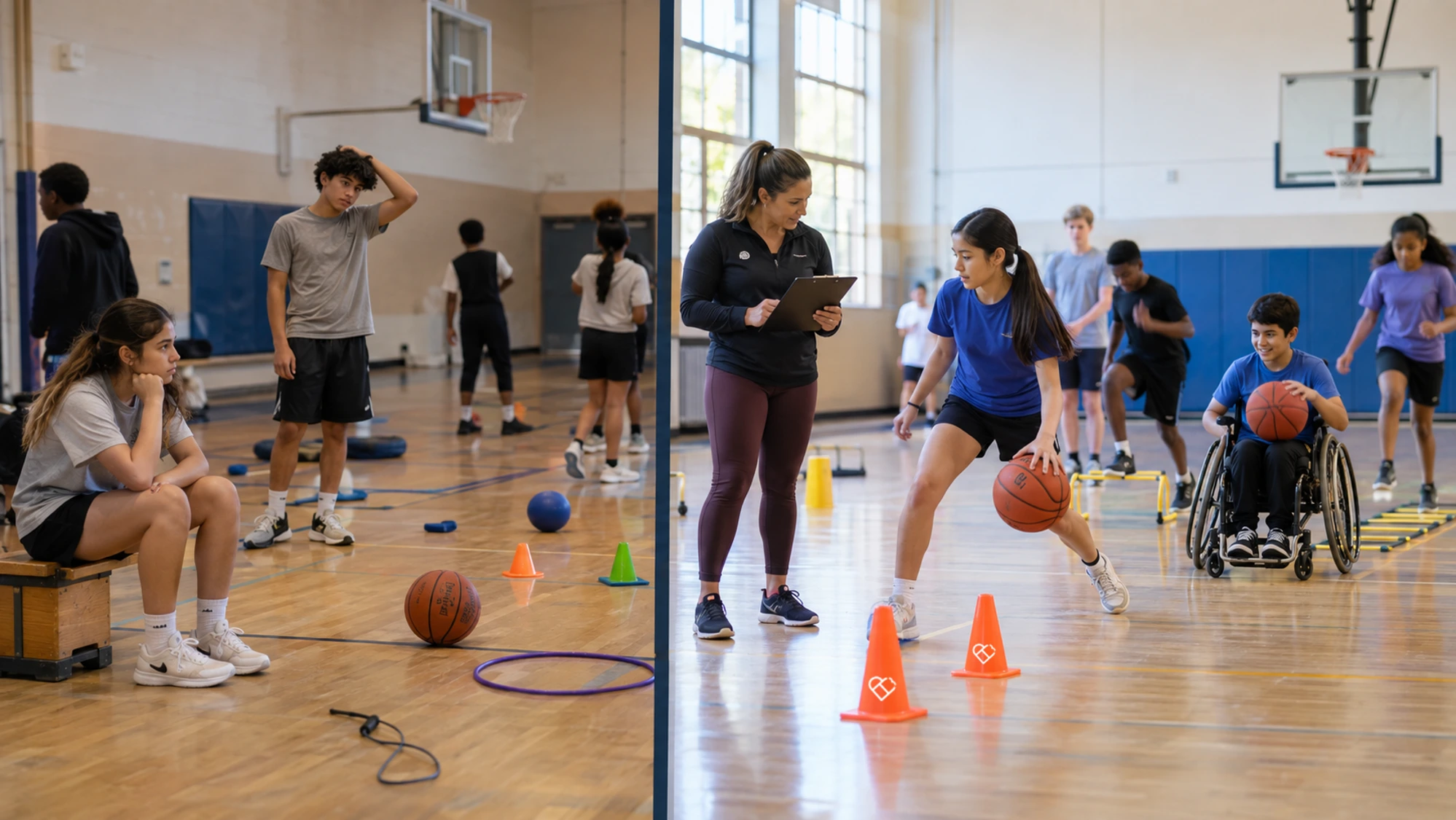
Physical education assessment should not be optional. When states or districts remove the expectation to assess student learning in PE, they may intend to reduce testing pressure or protect instructional time—but the practical result is often less equitable, less effective physical education for the students who need it most.
The answer is not to return to public fitness rankings, one-size-fits-all performance tests, or grading students on athletic ability. The better approach is meaningful, developmentally appropriate, standards-based assessment that helps teachers understand what students are learning, identify barriers, provide feedback, and improve instruction.
National PE Policy Tracker 2026
PE is a subject where students learn movement skills, fitness knowledge, safety practices, personal goal-setting, cooperation, and lifelong activity habits. If schools say those outcomes matter, they must also have a responsible way to determine whether students are actually learning them.
Assessment Is Part of Teaching
Assessment is often misunderstood as a final test, a fitness score, or a grade in a digital gradebook. In high-quality physical education, it is much broader.
Assessment is the process of gathering evidence about student learning so teachers and students can make better decisions. It can include:
- Observing a student’s throwing, jumping, striking, balancing, or movement patterns.
- Using a simple rubric during a small-sided game or skill practice.
- Asking students to explain a fitness concept, safety decision, or tactic.
- Having students set a realistic personal activity goal and reflect on progress.
- Using exit tickets, self-assessments, peer feedback, heart-rate checks, or movement journals.
- Reviewing class-level evidence to see whether the curriculum and instructional approach are working.
The key distinction is this: assessment is not the same as high-stakes testing. A well-designed assessment system supports learning; it does not shame students, sort them by natural ability, or reduce PE to a single fitness number.
SHAPE America’s National Physical Education Standards describe PE as a subject in which students develop motor skills, apply movement and fitness knowledge, build social skills through movement, and develop personal skills, goal-setting, reflection, and motivation for lifelong activity. Those are learnable outcomes—and they require evidence of learning.shapeamerica
What Happens When PE Assessment Becomes Optional?
When a district treats assessment as optional, inconsistent implementation becomes predictable. Some teachers may continue to assess regularly and thoughtfully. Others, often working with large classes, limited planning time, inadequate equipment, or little professional development, may have no structure or support to do so.
That inconsistency hurts students in several ways.
1. Students Receive Less Useful Feedback
Without assessment, students may participate in activities without knowing what they are trying to improve or whether they are improving.
Consider two versions of the same volleyball unit:
| Without meaningful assessment | With meaningful assessment |
|---|---|
| Students rotate through drills and games | Students know the lesson target: move into position, use a ready stance, and send a controlled pass to a partner |
| Teacher sees who appears athletic | Teacher uses a short rubric or observation checklist tied to the skill criteria |
| Feedback is mostly general: “Good job” or “Try harder” | Feedback is specific: “Your platform is too narrow; widen it and angle it toward your target” |
| Grades may reflect participation or compliance | Students demonstrate growth, explain technique, and set an improvement goal |
| Students who struggle can disappear in the crowd | Teacher identifies who needs a modification, extra practice, or different entry point |
Students deserve feedback that tells them what they can do now, what they are learning next, and how to improve. Eliminating assessment removes one of the main ways PE becomes instruction rather than supervised recreation.
Optional Assessment Can Hide Opportunity Gaps
Assessment is also an equity issue.
Students arrive in PE with very different experiences. One student may have access to private sports leagues, safe parks, equipment, family transportation, and adults who can teach skills outside school. Another may have none of those opportunities. A student with a disability may need adapted equipment, a different task design, or more time to demonstrate learning. An English learner may benefit from visual cues, demonstrations, and multiple ways to respond.
If teachers do not assess learning, they have less information about who is being served well and who is being left behind.
This does not mean students should be compared against one another or required to reach identical athletic benchmarks. It means every student should have access to instruction, feedback, and evidence-based opportunities to progress from their own starting point.
A standards-based approach asks better questions:
- Can the student perform or apply the skill being taught?
- Does the student understand how and why to use the skill?
- Can the student make safe, appropriate decisions during activity?
- Can the student identify strengths, barriers, and next steps?
- Is the teacher adapting instruction so every learner can participate meaningfully?
Without those questions, inequities are easier to overlook—and harder to correct.
It Weakens the Case for PE
Subjects that are not assessed are often treated as less essential.
When schools do not collect credible evidence of PE learning, it becomes harder for teachers and leaders to show:
- Whether students are meeting state or local PE standards.
- Which skills, concepts, or grade levels need instructional attention.
- Whether curriculum changes are improving learning.
- Where teachers need professional development.
- Whether equipment, staffing, facilities, and scheduling are sufficient.
- How PE contributes to student health, engagement, and schoolwide wellness goals.
This matters because PE already competes for time, staffing, facilities, and funding. A program that cannot show what students learn is more vulnerable to being shortened, replaced, or treated as a planning-period convenience.
Schools are uniquely positioned to help young people build healthy behaviors. The CDC notes that children and adolescents should get 60 minutes or more of physical activity daily, and it identifies schools as an important setting for supporting physical activity, health, focus, and academic outcomes. PE cannot provide all 60 minutes by itself, but it is the one part of the school day specifically designed to teach students the knowledge, skills, confidence, and habits needed to be active beyond class.cdc
“Optional” Often Means Unequal
A common rationale for making PE assessment optional is flexibility. Districts may want to honor teacher autonomy, avoid burdensome reporting systems, or reduce concerns about fitness testing.
Those concerns are legitimate. But making assessment optional is usually the wrong solution.
When assessment is optional:
- Students’ learning experiences can depend heavily on which teacher they happen to have.
- Teachers with fewer resources may be least able to implement quality assessment.
- New teachers may lack clear expectations or models.
- District leaders lose visibility into whether students have equitable access to standards-based learning.
- PE can drift toward “roll out the ball” programming, where activity occurs but learning is not intentionally taught or documented.
Flexibility should exist in how teachers assess, not in whether student learning matters.
A district can establish common learning expectations while allowing teachers to choose appropriate tools: skill rubrics, video reflection, teacher observation, student conferences, fitness knowledge checks, goal-setting logs, or performance tasks. The goal is not uniform paperwork. The goal is valid evidence that students are learning.
The Real Problem Is Bad Assessment, Not Assessment Itself
Critics are right to reject harmful practices. PE assessment becomes damaging when it is used to embarrass students, reward genetics, penalize disability, reinforce body-size stigma, or create public comparisons.
For example, grading a student primarily on how fast they run, how many pull-ups they complete, or whether they reach an arbitrary fitness score is not an equitable measure of learning. Those outcomes may be influenced by maturation, prior opportunity, disability, health status, body composition, access to activities outside school, and many other factors.
Fitness assessment can have educational value only when it is handled appropriately:
- Use it privately, not as a public ranking or competition.
- Teach students what the measure means and does not mean.
- Focus on personal understanding, goal-setting, and healthy behavior—not body shame.
- Use developmentally appropriate protocols and accommodations.
- Avoid tying grades primarily to performance outcomes outside a student’s immediate control.
- Connect results to instruction, reflection, and realistic next steps.
SHAPE America has emphasized that fitness education and assessment should be integrated intentionally into comprehensive, standards-based PE; be developmentally appropriate; support every student; and be informed by scientific evidence. It also stresses movement away from performance-based models toward approaches that prioritize health, learning, and lifelong physical activity.shapeamerica
That is the model schools should strengthen—not abandon.
What Meaningful PE Assessment Looks Like
A strong PE assessment system should be practical enough for real teachers and meaningful enough for real students.
Assess the full scope of PE learning
PE assessment should go beyond athletic performance and include evidence related to:
- Motor-skill development and movement competence.
- Knowledge of movement concepts, tactics, and fitness principles.
- Safe participation and responsible use of equipment and space.
- Personal and social skills, including cooperation, communication, respect, and problem-solving.
- Goal-setting, self-monitoring, reflection, and understanding the personal value of physical activity.
These areas align with SHAPE America’s national standards, which include movement skills, movement and fitness knowledge, social skills, and personal skills that help students choose and sustain meaningful physical activity.shapeamerica
Use formative assessment frequently
Formative assessment happens during learning, not just after a unit ends. It helps teachers make immediate instructional adjustments.
Examples include:
- A teacher scans students during a lesson using a three-item checklist.
- Students show a thumbs-up, sideways, or down to self-report understanding of a tactic.
- Partners use one success criterion to offer feedback.
- Students identify one cue they used successfully and one cue they will practice next.
- A class completes a 60-second exit response: “Name one way to increase the intensity of a cardio activity safely.”
These tools take minutes, not entire class periods.
Use summative assessment selectively
Summative assessment provides a snapshot at the end of a learning sequence. It should reflect what students had a genuine opportunity to learn and practice.
A summative assessment might ask students to:
- Demonstrate a skill in a modified game or practice task.
- Explain how the FITT principle applies to a personal fitness goal.
- Design a safe warm-up for a chosen activity.
- Use a rubric to analyze their own performance.
- Create a realistic plan for participating in a preferred physical activity outside of school.
The strongest assessments allow students to demonstrate learning in more than one way.
Report growth and learning—not athletic status
A PE grade should communicate what a student learned. It should not be a reward for being naturally fast, coordinated, thin, competitive, or already experienced in sports.
Schools should avoid grading systems dominated by:
- Wearing the “right” clothing when students may lack resources.
- Attendance when absences may be beyond a student’s control.
- Participation points that reward compliance but reveal little about learning.
- Fitness scores based largely on biological differences or out-of-school opportunity.
- Behavior-only grades that blur the difference between conduct and achievement.
Instead, grades should reflect standards-aligned evidence, clear success criteria, opportunity to practice, student improvement, and appropriate accommodations.
A Better Policy Than “Optional”
States and districts do not need a rigid, high-stakes PE testing mandate. But they should maintain a clear expectation that schools assess student learning in physical education.
A responsible district policy could include the following:
- Require standards-based assessment in PE. Every student should have regular opportunities to demonstrate learning connected to adopted standards and curriculum.
- Protect teacher flexibility. Teachers should be able to select developmentally appropriate methods rather than being forced into a single commercial test or uniform assessment format.
- Separate fitness education from fitness shaming. If fitness measures are used, use them privately and instructionally—not as public rankings or the sole basis for grades.
- Provide time, training, and tools. Assessment quality will not improve through policy alone. Teachers need manageable rubrics, digital or paper systems, calibration opportunities, and professional learning.
- Use data to improve instruction. Districts should review aggregated results to identify curricular gaps, resource needs, inequities, and professional-development priorities—not to punish students or teachers.
- Ensure accessibility and inclusion. Every assessment must allow for accommodations, adapted equipment, alternate demonstrations of learning, and culturally responsive instructional design.
- Communicate clearly with families. Families should understand that PE assessment measures learning, growth, knowledge, and personal skill development—not a child’s body type or athletic potential.
The Bottom Line
Making assessment optional in PE does not protect students from poor assessment. It often leaves students with less feedback, fewer supports, weaker accountability, and more unequal learning experiences.
The solution is not more testing for testing’s sake. The solution is to make assessment purposeful, private when appropriate, standards-aligned, inclusive, and useful to both teachers and students.
High-quality PE helps students develop movement competence, fitness knowledge, social skills, confidence, self-awareness, and habits that can support a lifetime of physical activity. Those outcomes are too important to leave unmeasured.
If schools truly believe physical education is part of a well-rounded education, then they must also believe every student deserves to know: What am I learning? How am I progressing? What can I do next?
