
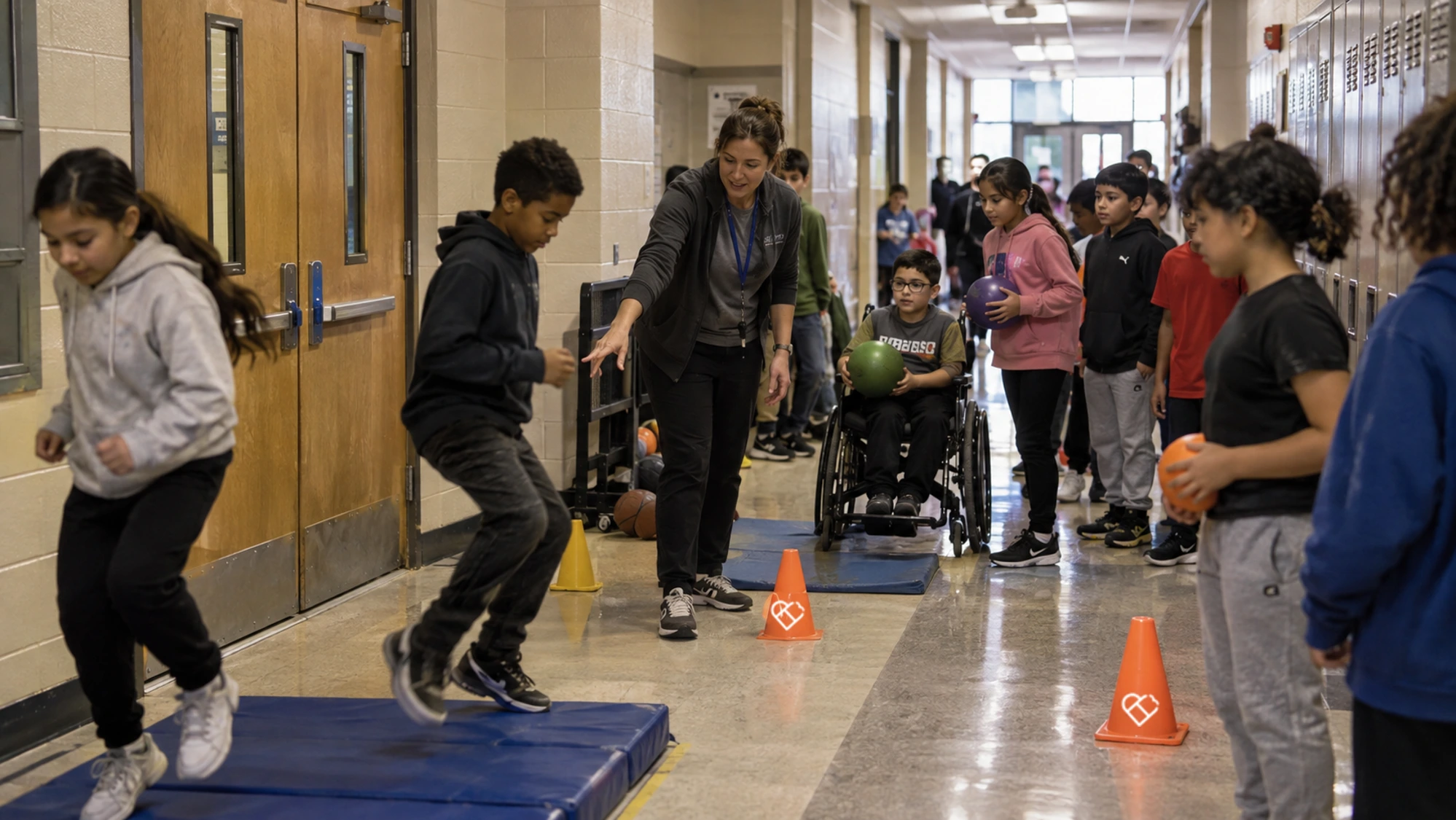
When the gymnasium at one Minnesota school was closed for renovation, the PE teacher didn’t get a backup space. There was no alternative indoor facility. So for an entire school year — plus a month into the next one — classes happened outside. Through snow, rain, thunder, and bitter cold. On indoor days, students squeezed into classrooms, hallways, and stairwells. During testing periods, they had to stay quiet and do silent activities. The gym wasn’t just “shared” with other events — it was gone (SHAPE America, 2022).
This is what inadequate PE funding and resources look like in practice. Not always a dramatic crisis — often just a slow erosion of space, equipment, and time that makes quality instruction nearly impossible. And the consequences reach far beyond the gym doors.
Quick Answer
Inadequate PE funding and resources — broken equipment, no dedicated budget, and shared gym spaces — reduce active learning time, increase off-task behavior, and limit academic benefits. Evidence-based strategies like station-based instruction, protected scheduling, and external grants can help schools mitigate these gaps.
PE Funding and Resources: The Scope of the Problem
Physical education is required in 83% of countries worldwide. Yet UNESCO calls it a “fringe subject” in many schools, and the PE funding and resources gap is staggering: nearly two-thirds of countries invest less than 2% of their education budgets in PE (UNESCO, 2024).
In the U.S., the picture isn’t much better. A national study of K–12 schools found that nearly 30% of schools have no dedicated PE equipment budget at all. Among the schools that do have one, the median is just $500 per year — about $1.30 per student. The researchers didn’t mince words: they called it “a very paltry amount for instructional materials” (ERIC, 2017).
A U.S. Government Accountability Office investigation found that officials at 9 of 13 schools visited cited inadequate facilities as a major barrier to teaching PE. Budget cuts in one district had reduced elementary PE to as little as 30 minutes every 2–3 weeks (GAO, 2012).
That’s not a program. That’s a token gesture.
Broken Equipment Doesn’t Just Slow Things Down — It Changes Behavior
Here’s what happens when you don’t have enough gear: kids wait. And when kids wait, they find other things to do.
The SHAPE America guide on classroom management in PE is blunt about this. Students who are stationary and waiting start talking, spinning on the floor, touching each other, fiddling with equipment — not because they’re “bad kids,” but because they’re bored and under-stimulated. Inefficient transitions, equipment setup delays, and long lines all feed the same cycle (SHAPE America, 2018). For more on creating evidence-based teaching practices that keep students engaged, check out our guide on PE instructional strategies.
The national ERIC study confirms it: lack of adequate equipment was directly associated with management issues and poor student behavior, especially when there wasn’t enough gear for everyone to participate at the same time (ERIC, 2017).
But here’s the flip side. When one school received a new curriculum and $3,500 worth of PE equipment, teachers were able to keep students more active, meet their needs better, and generate genuine enthusiasm for PE — from both students and staff. The equipment didn’t solve everything, but it removed a massive barrier (ERIC, 2017).
How Much Time Are Kids Actually Moving?
Research on PE instructional time is eye-opening. Studies have found that one-third or more of class time is spent on instruction and management tasks — not physical activity. That means in a 40-minute class, kids might be moving for 25 minutes at best, often less (SHAPE America, 2018).
When equipment is scarce, that number drops even further. More waiting. Less moving. More behavior issues. Less learning.
What About Academics?
Some administrators assume that cutting PE time to add more math or reading will boost test scores. The evidence says otherwise. The Institute of Medicine reviewed 14 studies on physical activity during the school day and found that 11 of them showed a positive relationship between physical activity and academic performance. Their conclusion: reducing PE to increase academic instruction “may not have the desired effect” (Institute of Medicine, 2013).
At Spooner Middle School, students who got daily outdoor exercise — biking, hiking, cross-country skiing — showed better academic gains, fewer disciplinary problems, and increased classroom attention compared to peers in computer-based interventions. The school repeated the study for two additional years with similar results (SHAPE America, 2024).
“We Lost the Gym Again” — When Shared Spaces Steal Instructional Time
Every PE teacher knows this one. The gym is booked for a concert. Or an assembly. Or standardized testing. Or construction. Suddenly, your class is in the cafeteria, the hallway, or — if you’re lucky — a stairwell.
It’s not a rare occurrence. According to GAO data from 2006, 54.9% of elementary schools used a cafeteria, auditorium, or other multipurpose room for indoor PE. At one school where the gym doubled as the cafeteria, the time needed to set up lunch, serve, and clean up seriously limited PE scheduling (GAO, 2012).
An evaluation from Arlington Public Schools found that almost half of elementary teachers lost four to six minutes of instructional time just getting students to and from PE class (Arlington Public Schools, 2023). That’s before any teaching even starts.
When PE gets pushed into a hallway or classroom, the lesson doesn’t just shrink — it transforms. You can’t run a soccer unit in a corridor. You can’t do cardiovascular drills between desks. The activity options narrow, and the lesson becomes a management exercise rather than a learning experience. These space constraints also intersect with student behavior and social-emotional learning, as students with fewer movement opportunities often struggle with self-regulation.
The Ripple Effect: What Neglect Actually Costs
Let’s connect the dots. When PE programs are starved of resources, the impact cascades:
Equipment shortages lead to longer wait times, which create the conditions for off-task behavior — not because kids are misbehaving, but because they’re idle (ERIC, 2017; SHAPE America, 2018).
Shared spaces steal instructional minutes. Every minute spent relocating, waiting for the cafeteria to clear, or squeezing into a hallway is a minute not spent in moderate-to-vigorous physical activity (GAO, 2012).
Less physical activity means fewer academic and behavioral benefits. Students in daily physical activity programs show better academic gains, fewer discipline problems, and improved attention (SHAPE America, 2024).
Teacher burnout follows. PE teachers with excessive student loads, inadequate resources, and unrealistic expectations face burnout and leave the profession — which further destabilizes programs (ERIC, 2017). For practical approaches to managing this, see our guide on large-class physical education strategies.
The cost of neglect isn’t just lower fitness scores. It’s worse behavior, less engagement, fewer academic benefits, and higher teacher turnover.
What PE Teachers Can Do Right Now
You don’t need a massive budget to make meaningful changes. Here are evidence-based strategies that work within real constraints.
1. Go Station-Based to Kill the Waiting Game
Instead of one activity with 30 kids in a line, set up 4–6 stations around your space. Fitness stations, jump-rope stations, skill drills — everyone’s moving at once. This works in cafeterias, hallways, and small gym spaces. SHAPE America specifically recommends this approach for teaching without a gym (SHAPE America, 2022).
2. Distribute Equipment Like It’s a System, Not an Afterthought
Don’t waste five minutes handing out balls. Place equipment around the perimeter of your space so students grab it on command. Assign squad leaders to manage distribution. Keep gear out of storage containers and ready to go. The SHAPE America management guide is packed with these tactics (SHAPE America, 2018).
3. Nail Your Transitions
Establish clear, taught signals — a whistle, music, verbal cues like “stop” and “freeze.” Teach students what each signal means: stop, set down equipment, look at the teacher, get ready. Rhythmic signals (clap-clap, stomp-stomp) work great for younger students. The faster you transition, the more time kids spend moving (SHAPE America, 2018).
4. Own the Space You Have
No gym? Let the seasons drive your units. Soccer in the fall when it’s cool enough to run. Sledding and winter games when it snows. Fitness stations and speed-stacking in the cafeteria. Hallway fitness workouts. Stairwell cardio drills. One PE teacher in Minnesota taught outside for an entire school year — through snow, rain, and bitter cold — and students ended up loving it (SHAPE America, 2022).
5. Design for Maximum Participation
Drop elimination games — they leave half the class watching. Use small-sided games where everyone plays. Partner activities, reaction drills, small-group challenges. The goal is simple: if a student is in your class, they should be moving for as many minutes as possible. For inclusive approaches that work across ability levels, see our guide on inclusive PE strategies.
What Administrators Need to Hear
If you’re a principal or district administrator, the research points to three investments that pay off.
Audit Your Equipment — Then Budget for It
The median PE equipment budget in U.S. schools is $500. Thirty percent of schools have nothing. Conduct an equipment audit, identify what’s broken or missing, and establish a replacement cycle. PE equipment wears out — without a dedicated budget, teachers can’t sustain quality instruction (ERIC, 2017).
Protect the Gym Schedule
Every time the gym gets taken for an assembly, PE loses. Work with your scheduling team to minimize conflicts. When the gym must be used, designate an alternative PE space in advance — and make sure it’s actually usable, not just a leftover classroom.
Keep Teaching Loads Manageable
Schools where each full-time PE teacher served fewer than 550 students were more likely to offer daily PE, meet weekly minute requirements, and conduct fitness assessments. High teaching loads are associated with reduced PE time, lower assessment rates, and teacher burnout (ERIC, 2017). Globally, only 44.7% of primary school PE teachers are specialists — and the number is declining (UNESCO, 2024).
Chase External Funding
ESSA Title IV-A funding designates health and PE as part of a well-rounded education — that’s a real funding pathway. Historically, the Carol M. White Physical Education Program provided nearly $79 million annually for PE equipment and instruction. One PE teacher raised $149,000 over five years through grants, awards, and donations. Sources include local hospitals, professional sports teams, and local businesses (SHAPE America, 2024; GAO, 2012). For more on building a comprehensive approach to school health, see our guide on comprehensive school physical activity programs (CSPAP).
The Bottom Line
PE programs don’t need luxury facilities. They need functional equipment, protected instructional time, and reasonable class sizes. When schools shortchange these basics, the consequences are real: students wait longer, behave worse, move less, and miss out on the academic and behavioral benefits that physical activity provides.
The evidence is clear. Investing in PE isn’t about physical health alone — it’s about academic performance, student behavior, and school climate. The question isn’t whether schools can afford to invest in PE. It’s whether they can afford not to. If your school is ready to improve fitness assessment reporting alongside equipment and space upgrades, start with an audit of what you have and what you need.
FAQ
How does lack of equipment affect student behavior in PE?
When there isn’t enough gear for everyone to participate at once, students wait. And waiting leads to off-task behaviors — talking, fidgeting, distracting peers. A national study found that inadequate equipment was associated with management issues and poor behavior, especially when students couldn’t all participate simultaneously (ERIC, 2017).
How much instructional time do PE teachers lose to shared gym spaces?
It varies, but it’s significant. One evaluation found that almost half of elementary teachers lost four to six minutes just transporting students to and from PE. When the gym is shared with cafeteria functions, scheduling PE becomes even harder. A GAO report found that 54.9% of elementary schools used cafeterias or multipurpose rooms for indoor PE (GAO, 2012; Arlington Public Schools, 2023).
How much of PE class time do students actually spend physically active?
Research suggests only about one-third of class time is spent in physical activity. The rest goes to instruction, management, and waiting. This is why efficient routines and adequate equipment matter so much — they protect the minutes that actually count (SHAPE America, 2018).
What can PE teachers do when they don’t have a gym?
Use station-based instruction in cafeterias, hallways, and classrooms. Adapt activities to the space you have. Let the seasons drive your unit order. Keep clear signals and routines to manage transitions fast. Activities like fitness stations, speed-stacking, juggling, and small-group challenges work in tight spaces (SHAPE America, 2022).
How much do schools typically spend on PE equipment?
Nearly 30% of U.S. schools have no PE budget at all. Among those that do, the median is $500 per year — about $1.30 per student. Researchers called this amount “very paltry” for instructional materials (ERIC, 2017).
Does cutting PE time improve academic performance?
No. The Institute of Medicine found that in 11 of 14 studies, physical activity during the school day was positively linked to academic performance. Cutting PE to add more academic time doesn’t produce the gains people expect — and it removes the cognitive and behavioral benefits of movement (Institute of Medicine, 2013).
What funding sources are available for PE programs?
ESSA Title IV-A funding is the primary federal pathway — it designates health and PE as part of a well-rounded education. Historically, the Carol M. White Physical Education Program provided nearly $79 million annually. Other sources include local hospitals, clinics, professional sports teams, and local businesses. One teacher raised $149,000 in five years through grants and donations (SHAPE America, 2024; GAO, 2012).
