
You have the equipment ready. You know how you want to group students. You have a progression in mind and a reasonable estimate of how long each part will take.
Then class begins.
The directions that seemed clear on paper confuse half the group. Students need another step before they are ready for the game. Or they grasp the skill faster than expected, and the activity you planned for the next fifteen minutes no longer offers much of a challenge.
The lesson plan did its job: it helped you prepare. Now the lesson is happening, and you have information you did not have when you wrote it.
Good teaching is not following the plan no matter what. It is using the plan’s purpose to decide what to do next.
A plan cannot predict every class
A lesson plan can account for likely differences in skill, space, equipment, and time. It cannot tell you exactly how students will respond on a particular day.
The same activity may work differently across class periods. One group understands a demonstration and gets started. Another needs to see a peer try it first. One class manages a four-person rotation easily; in another, the wait between turns is so long that students lose track of the task.
That does not mean planning is pointless. It means the plan is a preparation for teaching, not a script that overrides what you observe.
SHAPE America’s instructional guidance calls for PE teachers to adapt lessons for different classes while providing appropriate practice, feedback, inclusion, and safe participation. In other words, responding to the class in front of you is part of teaching the lesson well.shapeamerica
Look before you change anything
When an activity is not working, it is tempting to call an audible immediately. First, take a moment to identify the problem.
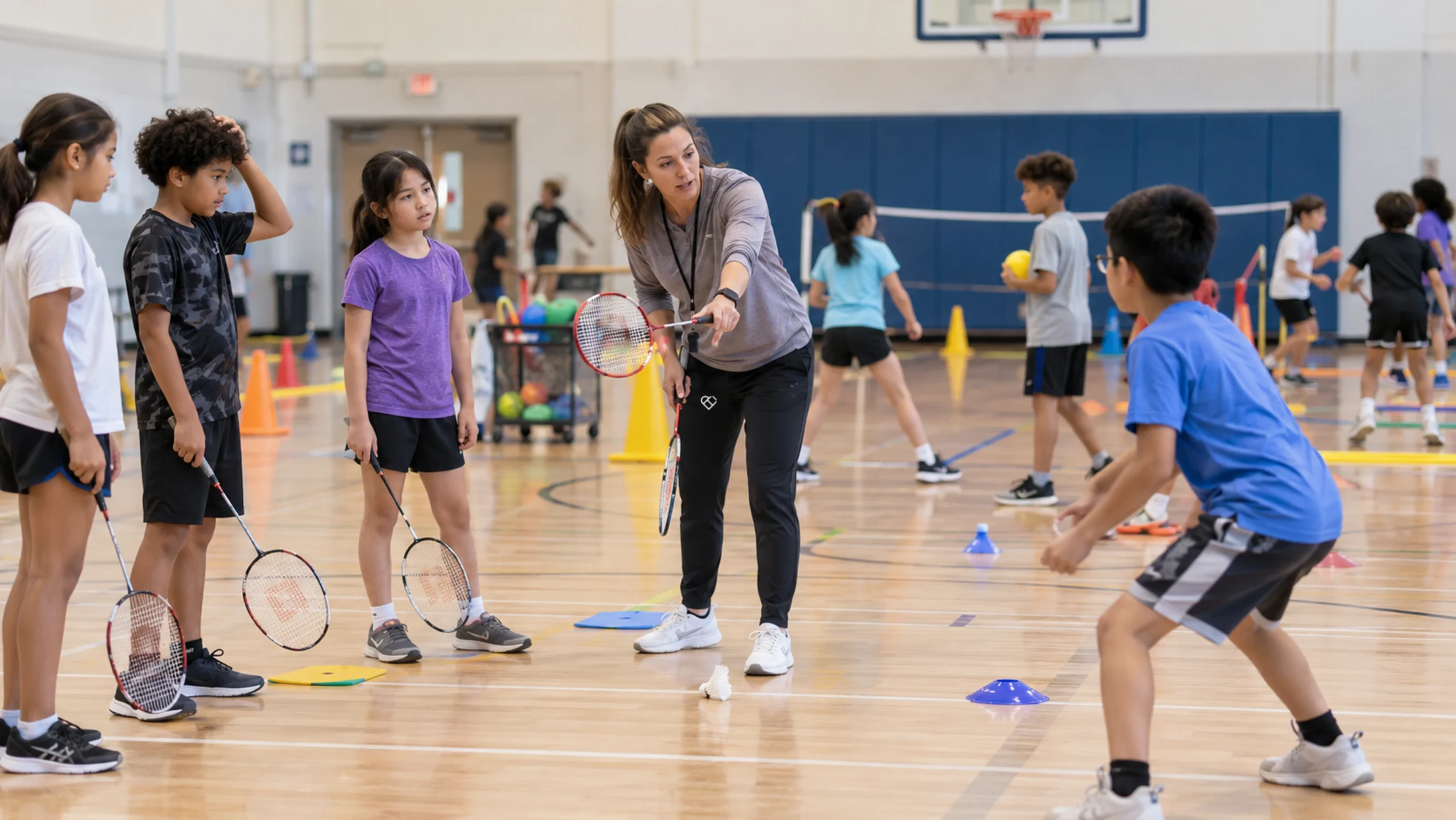
Suppose your goal in a badminton lesson is for students to send a shot toward open space. During a modified game, few students appear to be doing it. Why?
- They may not be making consistent contact yet.
- They may be able to hit the shuttle but not recognize open space.
- The rules may be demanding too many decisions at once.
- A confusing rotation may mean some students have barely had a turn.
Those are different problems. They should not all lead to the same adjustment.
Watch a few attempts and ask a quick question: “Where were you trying to send it?” You do not need to stop the whole class for a formal assessment. You need enough evidence to choose a useful next step.
This is the practical value of formative assessment. Research with PE teachers describes it as clarifying the learning goal, gathering evidence of where students are, and responding in ways that help them move forward. The researchers also found that using that evidence to adjust instruction is challenging—which is a good reason to keep the process simple.journals.sagepub
Change what is getting in the way
Once you know what the obstacle is, make the smallest useful adjustment.
If students need more support: Simplify the task without abandoning the goal. In badminton, a partner feed and a clear target may help students practice placement before returning to gameplay.
If students are ready for more: Add a decision, not just more repetitions. Students who can direct a shot toward one target might choose between two areas based on where a partner is positioned.
If groups are not working: Change the organization. Smaller groups, clearer roles, or a simpler rotation may give students more chances to practice.
If directions are not landing: Pause briefly and show the task. One demonstration and one cue can be more useful than repeating a long explanation.
If time is running short: Decide which part of the lesson best serves today’s goal. It is usually better to give students a meaningful chance to apply the skill than to rush through every activity on the page.
If space or equipment changes: Adapt the task to what is available, but check spacing, supervision, participation, and required accommodations before restarting.
The point is not to have a clever backup game for every situation. It is to understand which condition is preventing learning and adjust that condition. SHAPE America’s guidance emphasizes active practice, appropriate grouping, safe instruction, and inclusion—all useful checks when making a change on the fly.shapeamerica
Keep asking what students are learning
A class can look busy even when the original learning goal has disappeared.
If the badminton goal is to recognize and use open space, switching to an unrelated activity may solve a management problem but leave that goal behind. A smaller court, a controlled feed, or a modified rule might give students a better way to work on it.
Ask yourself: Does this adjustment give students a better chance to learn what I intended?
Often, the answer is to keep the goal and change the route. But that is not an absolute rule. If the space becomes unsafe or circumstances make the original task unworkable, change course. The goal helps you make a deliberate decision; it should never trap you in a bad one.
Prepare a few pivots, not another eight pages
Experienced teachers often seem able to adjust instantly because they recognize patterns: This group needs a shorter explanation. That task needs an easier entry point. This rotation is about to fall apart.
You can build that kind of readiness without writing an exhaustive plan. For each lesson, consider four questions:
- What will I watch for to know whether students are ready to move on?
- What simpler version still works toward the goal?
- What challenge comes next if students are ready early?
- What will I do if the grouping, time, space, or equipment does not work as expected?
A few notes might be enough:
Goal: Send a badminton shot toward open space.
Watch for: Students choose a target area when given a playable feed.
If too hard: Use partner feeds and one visible target.
If too easy: Offer two targets and ask students to choose.
If groups stall: Switch to pairs with clear hitter and feeder roles.
Teachers in a primary PE study reported that assessment connected to clear learning intentions helped their planning and feedback. They also described the burden of excessive paperwork and the importance of keeping students moving. The useful question is not “How much detail can I add to the plan?” It is “What information will help me teach?”dcu
Let one class improve the next
If you teach multiple sections, a quick note after class can save you from relearning the same lesson tomorrow.
“Period 2 needed a demonstration before partner practice.”
“Period 4 reached the challenge task sooner.”
“Groups of four meant too much waiting.”
That is enough. You do not need a lengthy reflection to remember what happened and plan a better starting point for that class next time.
Tools can help with this work. Ed, for example, can be used to organize a lesson’s goal, progressions, adaptations, and backup options. But whether you plan with Ed, a template, or a sticky note, no planning tool can make the in-the-moment observation for you.
A strong PE lesson plan gives you a purpose and a place to start. When the lesson does not go as planned, pay attention to what has changed, decide what students need, and teach from there.