
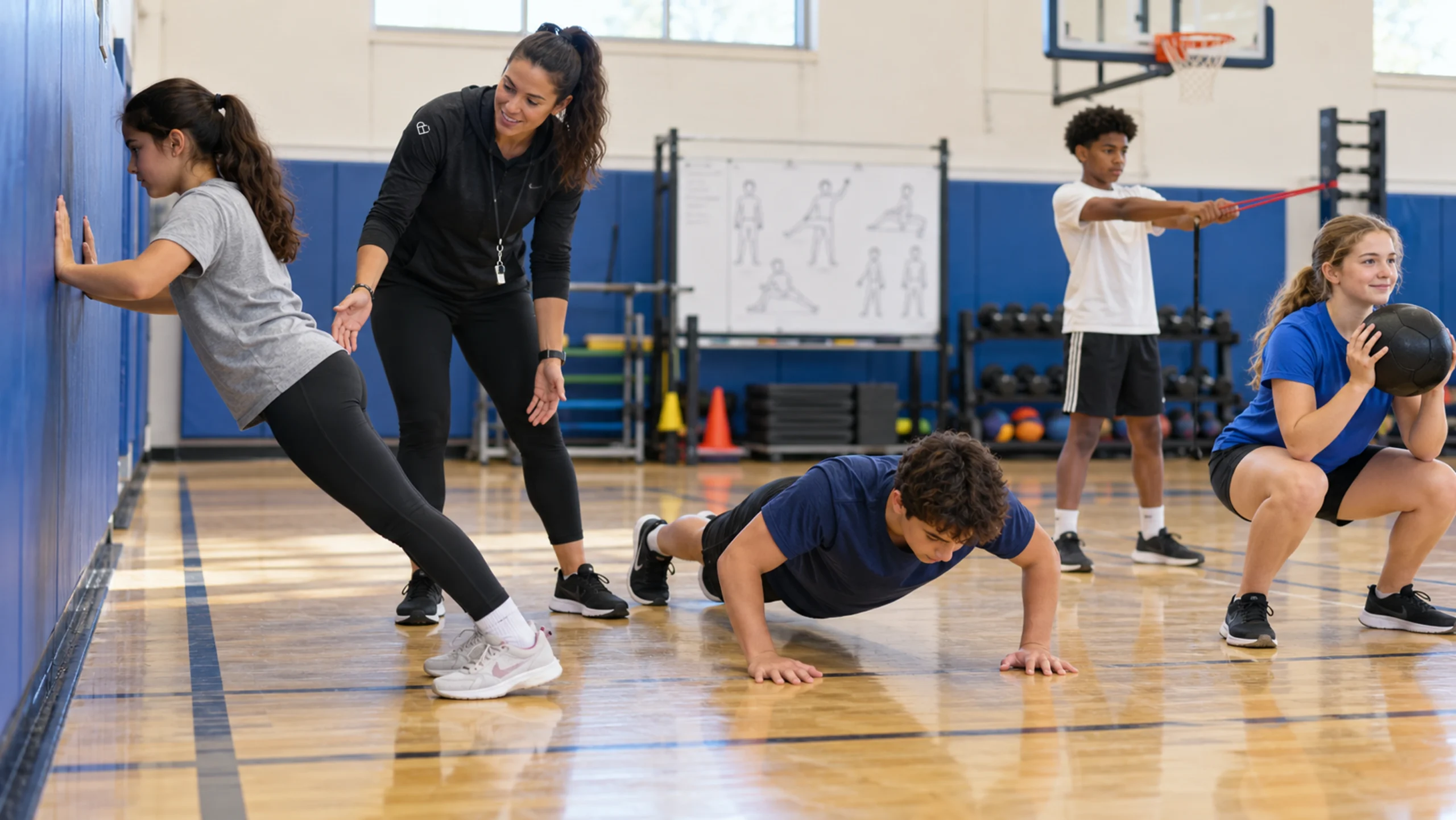
Teaching strength in K–12 PE is not about seeing who can lift the most. It is about helping students move with control, choose appropriate challenges, and understand how to build strength safely.
A student finishes ten push-ups. Another completes five against a wall. Which student learned more?
The repetition count cannot tell us. We would need to know whether each student understood the movement, selected an appropriate challenge, used feedback, and recognized when to stop.
That is the case for strength training education in PE. The goal is not simply to make students exercise harder. It is to teach them how to build strength safely, understand their bodies, and make informed decisions about physical activity.
Research supports that approach. The American Academy of Pediatrics’ 2020 clinical report describes youth resistance training as a worthwhile part of school physical education when qualified instruction, appropriate supervision, and technique-driven progression guide participation. Strength training can include bodyweight movements, resistance bands, and other suitable equipment—not just lifting weights.ncys
The most important word is education.
What Is Strength Training Education in PE?
Strength training education in PE teaches students how muscles work against resistance and how to participate safely and effectively. Resistance can come from their own body weight, elastic bands, free weights, or other appropriate equipment.ncys
An educational approach goes beyond assigning squats, push-ups, or a circuit. Students learn to:
- Perform a movement with control.
- Choose an appropriate exercise variation.
- Use equipment and shared space responsibly.
- Understand repetitions, sets, resistance, and recovery.
- Recognize when they need feedback or a different challenge.
- Explain how strength supports activities they value.
These are proposed learning goals, not a requirement to turn every PE lesson into a weight-room session.
A student who can explain why a wall push-up is the right starting point has learned something useful. So has a student who chooses a lighter resistance because the heavier option changes their technique.
What Does the Science Say About Youth Strength Training?
Children can gain strength before puberty
The idea that strength training offers little benefit until adolescence is not supported by the evidence summarized in the AAP report.
Children can increase strength before puberty. Early improvements occur largely through neurological adaptations: the nervous system becomes better at recruiting and coordinating the muscles needed for a task. Strength gains do not require large increases in muscle size.ncys
For PE teachers, this distinction matters. A strength lesson does not need to pursue bigger muscles to have value. Learning to produce and control force is a meaningful outcome.
Appropriately designed training has not been shown to stunt growth
Concern about growth plates has shaped many conversations about children and weights. However, the AAP’s review reports that appropriately designed resistance training has no apparent negative effect on linear growth or growth-plate health.ncys
That does not mean every exercise, load, or training environment is appropriate. It means the useful question is not, “Are children allowed to strength train?”
It is, “Is this activity appropriate for these students, with the instruction and supervision available?”
Safety depends on how the program is taught
Research summarized by the AAP supports low injury rates in well-supervised youth resistance training that emphasizes correct technique. Poor supervision, inappropriate increases in training load, and unsafe equipment use remain important concerns.ncys
“Strength training is safe” is therefore an incomplete message.
A more accurate message is: youth strength training can be safe and effective when the program matches students’ abilities and qualified adults teach, supervise, and progress it appropriately.ncys
Why Strength Training Education Belongs in PE—not Just Athletics
School athletics reaches students who join teams. Physical education has a broader responsibility.
The AAP report explicitly discusses resistance training for nonathletes as well as athletes and identifies benefits extending beyond sports performance, including muscular fitness, motor skill development, and physical literacy.ncys
That gives PE a different purpose from a competitive strength program.
Students do not need to pursue a lifting record to benefit from understanding resistance exercise. They need opportunities to learn what a manageable challenge feels like, how to improve a movement, and how to make responsible choices.
Strength training education in PE should therefore be organized around access and learning:
- Different starting points should be expected.
- Exercise variations should be normal, not treated as penalties.
- Progress should include better control and understanding—not only heavier resistance.
- Success should not depend on looking athletic or already feeling comfortable in a fitness setting.
The curriculum question is not, “Who is strongest?”
It is, “What should every student understand about developing strength?”
Strength Training Can Support Confidence—Without Making Appearance the Goal
Strength training offers students a concrete way to notice improvement: a movement becomes more controlled, a previously difficult exercise becomes manageable, or a student learns to use unfamiliar equipment.
There is research behind the confidence connection. A 2019 systematic review by Collins and colleagues included seven studies involving young people ages 10–16. Its meta-analysis found improvements in resistance-training self-efficacy—confidence in performing resistance training—as well as perceived strength, physical self-worth, and global self-worth.pmc.ncbi.nlm.nih
The findings need perspective. Only four studies contributed to the pooled analysis, study quality varied, and the review did not find clear improvements in every outcome, including perceived sport competence or body attractiveness.pmc.ncbi.nlm.nih
The practical implication is not that a strength unit will automatically transform every student’s confidence.
It is that strength training can provide opportunities to develop confidence in a specific, learnable activity. Teachers can build lessons around evidence students can recognize:
“I can choose a variation that works for me.”
“I know how to use feedback.”
“I can explain when I am ready for a harder challenge.”
That is a more useful educational target than asking students to judge their bodies in the mirror.
How Strength Training Connects to Lifelong Physical Literacy
Physical literacy involves moving with confidence and competence across activities and environments. The AAP identifies resistance training as one component of a broader approach to developing that capacity.ncys
In PE, that connection becomes practical when students learn more than an exercise sequence.
Consider two outcomes:
- A student remembers completing three rounds of a circuit.
- A student understands how to choose resistance, maintain control, allow recovery, and adjust an exercise.
The second outcome is knowledge the student can apply elsewhere.
However, lifelong participation should remain a goal—not an outcome schools promise from a short unit. Research supporting improvements in strength or confidence does not establish that a few PE lessons will produce lifelong exercise habits. The educational opportunity is to give students skills and understanding they can carry forward.
What Should Strength Training Look Like Across K–12?
The following progression is a curriculum example informed by youth resistance-training principles, not a fixed age-based prescription. Readiness depends on movement competence, experience, ability to follow instructions, and individual needs—not grade level alone. The AAP emphasizes training experience and demonstrated skill when planning progression.ncys
| Grade span | Suggested educational emphasis | Example learning task |
|---|---|---|
| K–2 | Body control, personal space, following movement cues | Practice a controlled sit-to-stand or short animal-movement activity with suitable alternatives |
| Grades 3–5 | Recognizing resistance and choosing manageable variations | Compare wall and incline push-ups and explain which allows better control |
| Grades 6–8 | Technique, basic training vocabulary, feedback, and recovery | Practice an approved movement, apply one teacher cue, and describe the adjustment |
| Grades 9–12 | Exercise selection, progression, and basic program reasoning | Create and justify a short routine using movements the teacher has already approved |
These are instructional starting points. A high school beginner may need foundational movement practice. An experienced younger student may demonstrate greater skill in a particular task. Neither should be assigned resistance simply because of age or appearance.
How to Teach Strength Training as Learning, Not Just a Workout
1. Start with one clear learning target
Replace “Today we are doing a strength circuit” with a target students can demonstrate:
“Today, you will choose a pushing exercise you can perform with control and explain your choice.”
Demonstrate the movement, show suitable variations, and give students one or two observable cues.
This translates the research emphasis on technique-driven progression into a teachable lesson structure.ncys
Large-class adaptation: Teach one shared movement first. Keep the number of variations manageable so you can observe the class rather than explain several unfamiliar exercises simultaneously.
2. Make progression a decision, not a reward
A harder exercise should not function as a prize for the “best” students.
Teach students to consider:
- Can I repeat the movement with control?
- Can I maintain the technique we practiced?
- Do I understand the next variation?
- Has the teacher approved the change?
The AAP recommends gradual progression based on consistently demonstrated resistance-training skill. It does not treat heavier loads as the automatic next step for everyone.ncys
Large-class adaptation: Use clearly labeled options and require a teacher check before students move to a new loaded variation. Students should not self-select unfamiliar heavy resistance.
3. Teach safety routines before adding complexity
Safety is part of the content, not a warning delivered once at the beginning of the unit.
Suggested routines include:
- Start and stop on the agreed signal.
- Maintain clear working spaces.
- Inspect equipment before use.
- Return equipment to its designated location.
- Ask before changing an approved exercise or resistance.
- Stop and tell the teacher about pain, dizziness, or other concerning symptoms.
Follow school health procedures and individual medical or accommodation plans. The AAP notes that some health conditions require medical consultation before participation in resistance-training programs.ncys
Large-class adaptation: Organize clear activity zones and unobstructed sightlines. If you cannot adequately supervise a task, simplify it, reduce the number performing it simultaneously, or remove it. A task card or peer partner cannot replace qualified supervision.
4. Keep feedback specific and body-neutral
Use feedback that helps students understand an action:
“You maintained control through each repetition.”
“That variation lets you practice the movement more consistently.”
“Pause and reset before the next repetition.”
Avoid making appearance, gender, or comparisons with classmates the organizing language of the unit.
This is a suggested teaching approach consistent with emphasizing competence and the specific confidence outcomes examined in resistance-training research. It is not a claim that one feedback script has been proven superior in every PE setting.pmc.ncbi.nlm.nih
Large-class adaptation: Give partners a narrow observation task, such as checking whether the student pauses and resets. Keep exercise approval, load changes, and safety decisions with the teacher.
5. Assess understanding alongside performance
If strength training education in PE is educational, assessment should reveal more than repetition totals.
A short assessment might ask students to:
- Demonstrate an approved movement with the taught cues.
- Explain why they selected a particular variation.
- Identify an equipment-safety rule.
- Describe when they would reduce the challenge.
- Explain why recovery belongs in a training plan.
These are suggested curriculum assessments rather than a validated testing battery.
Large-class adaptation: Observe a small group during each lesson while the rest practice familiar, approved tasks. Combine that observation with a brief exit question rather than trying to assess every student on every criterion at once.
A Simple Lesson Structure for Strength Training Education in PE
The following is an illustrative lesson framework, not a complete training prescription or a research-tested intervention.
Learning target
“I can select an appropriate exercise variation, demonstrate control, and explain one safety decision.”
Lesson sequence
- Introduce the purpose. Explain what students are learning and how it differs from simply completing repetitions.
- Prepare to move. Use a developmentally appropriate dynamic warm-up.
- Demonstrate one movement. Show the starting position, movement, stopping point, and approved variations.
- Practice with feedback. Use brief practice opportunities with adequate rest rather than a race.
- Apply a decision rule. Have students maintain or simplify the task based on control and teacher feedback.
- Reflect. Ask, “What made your variation appropriate today?”
The structure reflects the AAP’s emphasis on qualified instruction, appropriate warm-ups, correct technique, recovery, and progression matched to the participant.ncys
A brief lesson can teach an important skill. It should not be presented as equivalent to the repeated training used in studies demonstrating strength gains. Those gains depend on sufficient training exposure over time.ncys
What Schools Need to Make This Work
A weight room is not a prerequisite for introducing strength concepts. Bodyweight exercises and resistance bands are among the methods recognized in youth resistance-training guidance.ncys
But minimal equipment does not mean minimal preparation.
For school leaders, the priorities should be:
- Teacher preparation in youth resistance-training instruction.
- Equipment appropriate to students’ size and skill.
- Space and class organization that permit supervision.
- Clear procedures for equipment use and emergencies.
- Adaptations that allow students with different abilities to participate meaningfully.
- Curriculum time to revisit skills rather than rush through a one-time circuit.
The AAP identifies instructor expertise, the training environment, participant competence, and appropriate instructor-to-student ratios as relevant to safe implementation. It does not offer one universal ratio suitable for every exercise and class.ncys
Schools should therefore match the complexity of instruction to the conditions they can actually support.
Frequently Asked Questions About Strength Training Education in PE
Is strength training safe for elementary students?
Developmentally appropriate strength activities can be suitable for elementary students when qualified adults teach and supervise them. Bodyweight movements can provide resistance without requiring a traditional weight-room program. Readiness and instruction matter more than a single starting age.ncys
Does strength training stunt children’s growth?
Appropriately designed resistance-training programs have not been shown to harm linear growth or growth-plate health. That finding does not remove the need for suitable resistance, safe equipment use, and supervision.ncys
Do students need to lift heavy weights?
No. Strength training includes bodyweight exercises, resistance bands, and other forms of resistance. Beginners should develop technique with manageable resistance before progressing.ncys
Can strength training improve students’ confidence?
Research suggests it can improve confidence in performing resistance training and some aspects of self-worth. However, the evidence is limited, and benefits should not be assumed for every student or every dimension of confidence.pmc.ncbi.nlm.nih
Should PE classes include maximum-lift testing?
Maximum-lift testing is not necessary to teach foundational strength concepts. Although the AAP reports that properly administered testing can be safe under qualified supervision, a general PE curriculum can prioritize movement quality, decision-making, and understanding instead.ncys
Teach Students How to Build Strength—not Just How to Finish a Set
Strength training earns its place in physical education when students learn something they can use.
That might mean recognizing an appropriate starting point. It might mean asking for feedback, adjusting resistance, respecting recovery, or understanding why someone else’s exercise looks different.
Start with one movement, one clear learning target, and a challenge students can manage. Then assess whether they understand the decisions behind what they are doing.
The goal is not to graduate a class of weightlifters. It is to help students leave PE better prepared to participate with competence, confidence, and care.